Wood Frame Construction Manual for One- and Two-family Dwellings
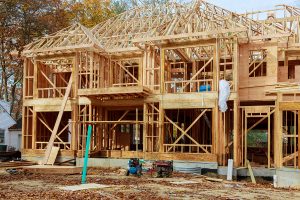
Photo © BigStockPhoto.com
by Bradford Douglas, PE
Information technology is no underground the construction industry must play an active part in enhancing resiliency, specially in high-wind and seismic areas where ongoing development continues to increase the number of buildings exposed to extreme conditions conditions. Fortunately, building codes and operation criteria are updated on a regular basis to address the need for improve planning and mitigation of such conditions.
The American Forest Quango'southward (AWC's) 2018 Forest Frame Construction Manual (WFCM) for one- and two-family dwellings is a referenced standard for forest design in the International Code Council'due south (ICC's) 2018 International Building Code (IBC) and 2018 International Residential Code (IRC). The publication equips designers and code officials with engineered and prescriptive construction methods resulting in more resilient wood buildings.
Images courtesy American Woods Council
Information technology likewise serves equally a useful tool in the design of non-residential buildings in Risk Category I or Ii fitting inside the 2018 WFCM scope of building size and assigned loads, such as commercial buildings where the bottom floor is used for retail, offices, and/or restaurants.
Practical guidance, technical detail
Developed past AWC's Forest Design Standards Commission, the updated publication offers both practical guidance and technical detail, covering forest pattern and construction provisions for connections and wall, floor, and roof systems for i- and two-family dwellings, equally well as a range of structural elements such as sawn lumber, structural glued laminated timber (glulam), wood structural sheathing, I-joists, and trusses.
Framing members attached with properly designed fasteners and connectors help to resist forces associated with high-wind and seismic events, as do diaphragms and shear walls made from wood structural panels (WSPs) properly fastened to wall and roof framing. For buildings within its scope, the 2018 WFCM contains both engineered and prescriptive solutions for wind, seismic, and gravity loads.
Tabulated engineered and prescriptive design provisions in the 2018 WFCM Chapters 2 and iii, respectively, are based on the post-obit loads from American Guild of Civil Engineers/Structural Engineering Plant (ASCE/SEI) 7-sixteen, Minimum Blueprint Loads and Associated Criteria for Buildings and Other Structures:
- 0 to 342 kg/grand2 (0 to 70 psf) ground snowfall loads;
- 145 to 314 km/h (90 to 195 mph) 3-2nd gust basic wind speeds; and
- seismic design categories A to D.
Updates in 2018
With the 2018 IBC and 2018 IRC bachelor for adoption and enforcement, it is important to note corresponding updates in the 2018 WFCM. Main changes include updated reference to and pattern loads from ASCE 7-16. The "Bones Air current Speeds for Ane- and Two-family Dwellings" figure has been revised based on the three-second Gust Basic Wind Speeds for Risk Category II Buildings to coordinate with updated reference to ASCE vii-xvi.
Requirements for identification and description of WSPs to recognize "Performance Category" consistent with IBC have been added. WFCM references to WSP thickness appear in several forms. References to WSP thickness were revised throughout the standard to consistently draw the panels and more than accurately depict thickness as a nominal value to coordinate with changes to 2018 WFCM Section 1.2.1.8 and the 2018 ICC codes. For case, 12 mm (xv/32 in.) WSP becomes nominal 12 mm (15/32 in.) WSP; 11 mm (7/16 in.) becomes nominal 11 mm (7/16 in.); and minimum panel thickness (in.) becomes minimum nominal panel thickness (in.).
Revisions take been incorporated to coordinate with ASCE 7-16's increased roof uplift requirements due to changes in localized roof wind blueprint pressures and improver of lower wind speed categories (eastward.thousand. 145, 153, 161, and 169 km/h [ninety, 95, 100, and 105 mph]).
The roof rafter uplift tables accept been updated to provide roof uplift requirements and maximum spans for roof rafters in accordance with ASCE 7-xvi localized roof wind blueprint pressures.
Fastener criteria from AWC'southward 2018 National Design Specification (NDS) have been incorporated into the manual to include provisions for roof sheathing band shank (RSRS) nails and fastener head pull-through design values.
Additionally, terminology used for rake overhangs has been clarified and rake overhang spotter blocks have been limited to 229 mm (9 in.) based on increased roof uplift requirements due to localized roof wind design pressures.
"Shear Wall Assembly Allowable Unit Shear Capacities," "Maximum Shear Wall Segment Aspect Ratios," and "Sheathing Type Adjustments" tables were revised to incorporate updated aspect ratio adjustments consistent with AWC's 2015 Special Design Provisions for Current of air and Seismic (SDPWS).
"Roof Sheathing Attachment Requirements for Wind Loads" tabular array was too revised to give common, box, and RSRS blast size and sheathing options by including requirements for uplift load per smash and fastener uplift capacity.
A free electronic version of the 2018 WFCM is now bachelor online in PDF format. Visit AWC for more details regarding these changes and to view a recent webinar to obtain free education credits. A print version of the standard is expected to be bachelor for buy in the coming months.
 Bradford Douglas, PE, is vice-president of engineering at the American Wood Council (AWC), which represents the interests of the North American wood products industry. Douglas directs a program aimed at developing state-of-the-fine art applied science data, applied science, and standards on structural forest products, systems, and assemblies for use by design professionals and building officials to clinch safety and efficient design and use of wood. He is a graduate of Virginia Tech. Douglas tin can be contacted at bdouglas@awc.org.

Source: https://www.constructionspecifier.com/american-wood-council-releases-new-manual/
0 Response to "Wood Frame Construction Manual for One- and Two-family Dwellings"
Post a Comment